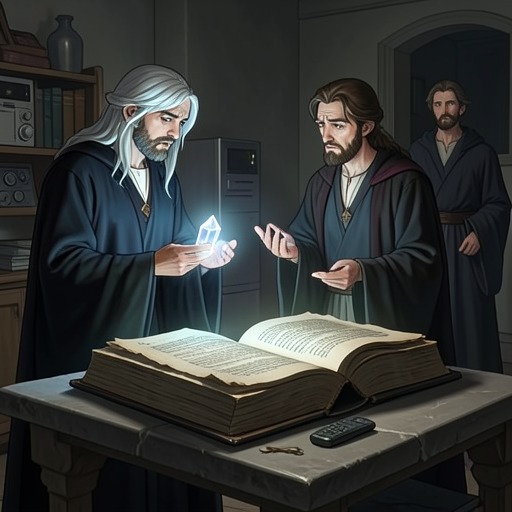
Umbral Regent
New Life as a Max Level ArchmageThe Umbral Regent is one of the Seven Cataclysms and the first Cataclysm slain by the Party of Heroes. His importance extends beyond his historical defeat: the book associated with him survives as a powerful mana-storage artifact, his minions and other remnants continued to threaten the mortal kingdoms after the Cataclysms ended, and his reputation helps shape the world’s persistent fear of an eighth catastrophe. He therefore functions as an absent but consequential antagonist, a figure whose death ended one crisis without making the possibility of future devastation disappear.
Identity and Historical Place
The Umbral Regent was once human, like the Shattered Oracle, but became a Cataclysm. Among the Cataclysms, he is described as the weakest and the most recently born, only a few centuries old. That ranking does not make him insignificant. His existence was sufficiently dangerous to place him among the world’s defining calamities, and his defeat became the first major Cataclysm victory credited to the Party of Heroes.
The chronology surrounding his fall is important. The Party of Heroes defeated the Umbral Regent before confronting the remaining Cataclysms, eventually overcoming all seven. A century after the final victory, the people of Prismarche still revered the heroes who had saved the world from horrors such as the Umbral Regent, the Maw of the Abyss, the Reaper of the Lost Harvest, and the Ashen Hierophant. The city’s temple displayed images of saints and heroes, including the celebrated party, while the Peace Day Festival commemorated a hundred years of freedom from the Cataclysms that had once ravaged the world.
Power, Remnants, and the Codex
The Umbral Regent’s most concrete surviving association is the Codex of the Hollowed Sun. Vivisari Vexaria recognized the book’s appearance because the Umbral Regent had worn a similar codex on his belt, although she had never seen him cast with it and did not believe the quest reward was necessarily the identical object. The System may instead have reproduced or appropriated its design, materials, or other features.
The surviving codex is a dark, blank-paged book that absorbs energy. Vivisari Vexaria identifies it as a mage’s accessory and, more specifically, as a secondary mana pool: a vast reservoir capable of storing her power for later use. Another mage could draw from it, though with extreme loss, perhaps retaining only one part in a hundred. Even that fraction of power would be formidable. The first page contains enough mana for Vivisari Vexaria to erase a city, or potentially for a mage such as Saffra to destroy a small village if she could channel the reservoir herself.
The artifact’s hunger gives the Umbral Regent’s legacy an almost physical presence. Its pages tug at the energy core within Vivisari Vexaria and react to every nearby power source; the book is described as starving and wanting to be fed. It is not cursed, but its capacity makes it useful even to Vivisari Vexaria, whose own strength is already extraordinary. That usefulness also troubles her, because a System-provided reserve of accumulated mana would be especially valuable if a threat capable of challenging her were approaching.
Aftermath and Continuing Threat
The Umbral Regent’s death did not immediately erase everything connected to his rule. Smaller calamities remained in the wake of the Cataclysms, and purging the lingering monsters placed a bloody burden on the mortal kingdoms. Among the surviving dangers were the Regent’s minions, alongside remnants associated with the Maw of the Abyss and other Cataclysms. This aftermath complicates the heroic narrative of final victory: the Party of Heroes killed the great enemy, but ordinary people still had to deal with what his age had left behind.
The question of why the Umbral Regent’s remnants were not simply eliminated also bears on the fate of the Sorceress. Rhek Verontell considers it difficult to believe that she died immediately after surviving the final confrontation, since she had defeated all seven Cataclysms and possessed enough strength to destroy lingering threats with ease. Yet the continued existence of lesser calamities and the absence of a sweeping purge provide an argument that she may truly have died. The Regent’s remaining minions thus become indirect evidence in a later mystery about the Sorceress, linking his past destruction to uncertainty about the world’s most famous survivor.
Fear of Another Cataclysm
The Umbral Regent belongs to a historical pattern that never becomes fully closed. Archmage Aeris warns that the Dragon King could descend from the Sky-Pillar Range and raze mortal lands, that an unknown horror might awaken from an ancient crypt, and that another Shattered Oracle could emerge from a single overambitious glimpse. His conclusion is that there is always an Eighth Cataclysm on the horizon, even when no immediate proof of one exists.
The Umbral Regent’s legacy makes that warning credible. He was once human, comparatively young among the Cataclysms, and supposedly the weakest of them, yet his transformation still produced a world-level threat. His example demonstrates that catastrophe does not require an ancient or uniquely powerful origin. The Codex of the Hollowed Sun intensifies the same unease: an artifact modeled on his equipment is not merely a relic of past evil but a practical source of stored power in the present. Its existence suggests that the world’s systems may be preparing for dangers that its inhabitants cannot yet see.
Narrative Significance
The Umbral Regent is characterized primarily through recollection, objects, and consequences rather than direct action in the present. His absence is part of his narrative force. Vivisari Vexaria remembers the codex he wore; the world remembers him as one of the Cataclysms; his minions survive as historical debris; and the possibility of a new disaster is measured against the scale of the threats he represented.
He also stands at the intersection of secular history and sacred memory. Prismarche’s temple presents the Party of Heroes as figures worthy of religiously inflected reverence, while the Peace Day Festival turns their victory into a public civic ritual. The Umbral Regent, by contrast, survives as the defeated power that gives those ceremonies their meaning. His defeat marks liberation, but the narrative repeatedly refuses to treat liberation as permanent. The world celebrates a century without the Cataclysms while still acknowledging that the next one may always be forming beyond the horizon.
In this way, the Umbral Regent is more than a defeated villain from an earlier age. He is a measure of historical scale, a source of dangerous artifacts, and a reminder that victory over an apocalypse does not abolish the conditions that make apocalypse imaginable. His first defeat by the Party of Heroes established the possibility of saving the world; his surviving traces preserve the fear that the world may someday need saving again.